
New Wild Horses collection is here  /  Dollar Deco Days  /  Subscription extras  /  End of month clearance
0%

Buying Foil Washi Tape across borders involves more than choosing a shiny pattern. Global buyers must examine foil adhesion, paper thickness, adhesive strength, print clarity, packaging, and supplier reliability. A roll may look excellent under showroom lights, yet lose its metallic surface during transport. Humidity can also affect the tape’s edge, release liner, and adhesive performance.

Mika Sato, a washi tape product-development specialist with more than twelve years of sourcing experience, says, “A beautiful foil effect means little if the tape cannot perform after shipping, storage, and repeated use.” Her observation reflects a common purchasing mistake. Buyers often compare prices before testing samples. That order should be reconsidered. A small sample can reveal uneven stamping, weak tack, difficult peeling, or color differences between batches.

This guide presents ten practical Foil Washi Tape buying tips for international purchasers. It considers artwork consistency, foil coverage, roll dimensions, core size, carton protection, minimum order quantities, lead times, and production inspection. It also explains how to review supplier documentation and communicate requirements clearly across languages and time zones. Ask for photographs. Request physical samples. Record approval details.

Do not trust appearance alone.

A reliable supplier should explain material structure, adhesive options, sampling procedures, and quality controls without vague promises. Buyers should also confirm shipping marks, product labeling, and destination-market requirements with qualified logistics or compliance professionals. Some recommendations may not fit every project. Handmade stationery, retail packaging, and promotional use have different priorities. Even experienced buyers can miss one detail. That is why careful comparison, written specifications, and realistic testing remain essential before placing a large Foil Washi Tape order.
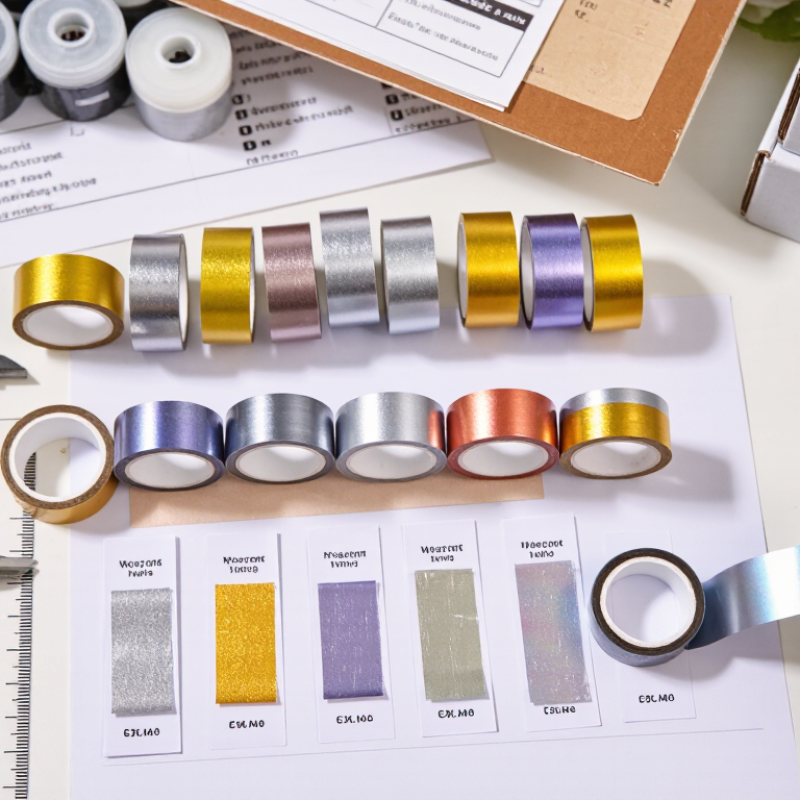
10 Foil Washi Tape Buying Tips for Global Buyers

Define Foil Washi Tape and Its Main Applications

Foil washi tape is a pressure-sensitive decorative tape with a paper-based backing and a thin metallic foil layer. The foil creates a reflective finish, while the paper backing keeps the tape light and hand-tearable. Adhesive strength varies widely. Some rolls lift cleanly from paper, but others may leave residue after several days.

Its main applications include journaling, invitation design, gift wrapping, scrapbooking, retail displays, and seasonal packaging. It can frame a product card, highlight a handwritten note, or add a narrow gold-like line to a parcel. Smithers’ packaging outlook forecasts the global packaging market will exceed US$1.3 trillion by 2028. That growth supports demand for affordable decorative finishing materials, including paper-based tapes. However, foil washi tape is not a structural sealing tape. It should not replace carton tape, safety labels, or permanent product identification.

Global buyers should inspect foil coverage, edge cutting, adhesive consistency, and color stability under indoor light. Request samples before placing volume orders. A glossy sample can hide uneven coating or weak adhesion. That assumption is easy to get wrong. The tape may also tear differently in humid conditions. ASTM D3330 peel testing can help compare adhesive performance, although small craft applications may need gentler adhesion. The Association for Packaging and Processing Technologies also emphasizes material consistency and packaging-line suitability in its industry guidance. Buyers should therefore confirm roll length, core size, backing material, storage conditions, and any intended surface before approval.

Evaluate Foil Quality, Adhesion, and Paper Compatibility

Global buyers should inspect foil washi tape beyond its shine. A bright surface can hide uneven coating, weak edges, or patchy transfer. Request samples with solid blocks, fine lines, and small lettering. Rub each design lightly with a dry cloth. Then bend the tape around a paper corner. Reliable foil should resist cracking and remain visually even. I once approved a glossy sample too quickly. Its finish dulled after repeated handling. That mistake changed my testing process.

Tip: Test adhesion on every target paper. Smooth coated paper, recycled stock, kraft paper, and textured card behave differently. Apply a five-centimeter strip, press it firmly, and peel it after one hour. Check for lifting, residue, tearing, and ink removal. Test again after twenty-four hours. Short tests can mislead. Humidity and temperature also affect performance during shipping and storage. A tape that works in a dry office may loosen in a humid warehouse.

Paper compatibility deserves equal attention. Strong adhesive may damage delicate fibers, while weak adhesive may fail on rough surfaces. Ask suppliers for adhesive type, backing thickness, foil process, and recommended storage conditions. Compare results using the same pressure and peeling angle. Keep dated test records, including photos. Do not rely on appearance alone. Global buyers should also confirm packaging details, batch consistency, and applicable material documentation before placing larger orders._久久爱

Compare Tape Sizes, Patterns, Finishes, and Customization Options

Foil Washi Tape Buying Tips for Global Buyers

When buying foil washi tape for international projects, compare dimensions before choosing colors. Common widths include 5, 10, 15, and 20 millimeters. Wider tape suits borders, while narrow tape works well for planners and gift wrapping. Check roll length carefully, because a lower unit price may hide shorter rolls. Request a physical sample before placing a large order. Measure the actual width, length, and foil coverage.

Patterns should match the application, not only the product photograph. Fine geometric lines may look elegant on paper but disappear on textured surfaces. Bold florals and repeated icons usually perform better for packaging accents. Ask whether the pattern repeats evenly across each roll. Finish also changes the visual result. Mirror foil reflects strongly, brushed foil looks softer, and holographic foil shifts under moving light. Matte coatings reduce glare but may weaken the metallic effect.

Customization can include colors, printed artwork, widths, core sizes, and packaging labels. Provide vector artwork and confirm the foil layer separately from the ink layer. Ask for proof approval and production tolerances in writing. Test adhesion on coated paper, cardboard, and lightly textured surfaces. I once approved a sample without checking edge alignment, and the final rolls looked slightly uneven. That was a useful warning. Supplier claims still need practical testing. Document sample results, carton details, and moisture protection before shipment.

10 Foil Washi Tape Buying Tips for Global Buyers

Compare common tape widths and roll lengths before reviewing pattern scale, foil finish, and customization requirements.

Narrow 5–10 mm tapes are suitable for borders and fine details, while 15–30 mm tapes provide broader decorative coverage. A 10 m roll is common for narrow and standard widths, whereas wider tapes are often supplied in 5 m rolls. Always confirm the exact pattern repeat, foil finish, adhesive performance, core size, and custom printing or packaging options with the supplier.

Verify Supplier Credentials, Product Samples, and Quality Standards

10 Foil Washi Tape Buying Tips for Global Buyers

Supplier credentials deserve more than a polished website. Request the legal company name, factory address, registration record, audit report, and export history. Verify that the certificate matches the manufacturing site, not only a trading office. The ISO Survey 2023 reported more than 1.26 million ISO 9001 certificates worldwide, but certification alone does not prove foil tape quality. Check the certificate scope and expiry date. Ask who performed the audit.

01

Tip: Order samples before discussing large-volume pricing. Test the tape on coated paper, glass, and textured card. Measure peel adhesion, release strength, foil coverage, color consistency, and edge cutting. ASTM D3330 can guide peel-adhesion testing, while ISO 29862 covers self-adhesive tape measurement methods. Leave samples in heat and humidity for several days. A sample that looks perfect on day one may curl later. I once overlooked this risk. It was an expensive lesson.

02

Tip: Request a written specification sheet. It should state roll width, length, core size, backing material, adhesive type, tolerance, and storage conditions. Ask for batch traceability and a pre-shipment inspection report. Paper-based products may also require responsible-sourcing documentation, depending on the destination market. Review packaging safety requirements with a qualified local adviser. Do not accept “premium quality” as a measurable standard. Define acceptance limits for wrinkles, missing foil, weak adhesion, and color variation before signing the purchase agreement.

Calculate Global Costs, Shipping Risks, and Import Requirements

When buying foil washi tape globally, calculate landed cost before comparing unit prices. Include tape, cartons, inland transport, freight, insurance, duties, VAT, brokerage, and storage. A $0.20 roll can become expensive after destination charges. I use this formula: landed cost equals total import expenses divided by sellable rolls. Keep a contingency of 8–15%. My spreadsheet is never perfect.

Shipping risk deserves separate attention. UNCTAD’s Review of Maritime Transport 2023 states that ships carry over 80% of world merchandise trade by volume. That dependence creates delays during port congestion, weather events, and equipment shortages. Foil surfaces can scratch, while paper cores may absorb moisture. Request moisture-resistant cartons, corner protection, and photographs before dispatch. Ask for actual carton dimensions, not estimates. Dimensional weight may exceed the product weight.

Import preparation also requires local verification. The World Bank’s Logistics Performance Index 2023 compares 139 economies and highlights customs efficiency and shipment reliability as critical performance factors. Confirm the correct HS classification with a customs broker. Do not assume decorative tape uses one universal code. Prepare a commercial invoice, packing list, origin details, material description, and adhesive information. Check labeling, packaging waste, and tax rules in the destination market. OECD Trade Facilitation Indicators report that full reform implementation could reduce trade costs by 14.3%. That figure is useful, but not guaranteed for a small shipment. Select Incoterms carefully, because a low freight quote may exclude destination handling and import clearance.

FAQS

What is foil washi tape?

It is decorative tape with a paper backing and a thin metallic foil layer. The surface reflects light. The paper backing keeps it lightweight and hand-tearable. Adhesive strength varies between rolls.

Where can foil washi tape be used?

Common uses include journaling, invitations, gift wrapping, scrapbooking, displays, and seasonal packaging. It can frame a product card or highlight handwritten notes. A narrow metallic line can decorate a parcel.

Can foil washi tape seal cartons permanently?

No. It is not structural sealing tape. Do not use it for carton closure, safety labels, or permanent identification. It mainly provides decoration.

What should buyers inspect before ordering?

Check foil coverage, edge cutting, adhesive consistency, color stability, roll length, and core size. Look for patchy areas or uneven edges. Appearance alone is insufficient.

How should foil quality be tested?

Request samples containing solid blocks, fine lines, and small lettering. Rub the surface gently with a dry cloth. Bend the tape around a paper corner. Reliable foil should remain even and resist cracking.

How can adhesive performance be compared?

Apply a five-centimeter strip to each intended paper surface. Press it firmly and peel it after one hour. Test again after twenty-four hours. Check lifting, residue, tearing, and ink removal.

Does paper type affect adhesion?

Yes. Coated paper, recycled stock, kraft paper, and textured card behave differently. Strong adhesive may damage delicate fibers. Weak adhesive may fail on rough surfaces. Paper compatibility needs real testing.

Can humidity and temperature change performance?

Yes. A tape that works in a dry office may loosen in a humid warehouse. Storage and shipping conditions can affect adhesion and tearing. The first test may mislead.

What information should buyers request from suppliers?

Ask about adhesive type, backing thickness, foil process, storage conditions, and recommended surfaces. Confirm batch consistency and material documentation. Keep dated records with photographs. I once trusted a glossy sample too quickly.

Conclusion

Buying Foil Washi Tape for international projects requires more than choosing an attractive design. Buyers should first understand its common uses, such as decoration, packaging, scrapbooking, journaling, gift wrapping, and creative product presentation. Evaluate the foil layer for smoothness, brightness, durability, and resistance to peeling, while also checking adhesive strength and whether the tape can be removed cleanly from intended paper surfaces. Paper compatibility is especially important for artwork, labels, and delicate stationery.

A reliable purchasing process should compare widths, lengths, patterns, metallic finishes, transparency, and available customization options. Request product samples to assess real performance before placing a large order, and verify the supplier’s production experience, quality-control procedures, material information, and relevant standards. Finally, calculate the complete landed cost, including unit pricing, packaging, freight, insurance, taxes, and possible delays. Confirm import documentation, labeling needs, and destination requirements in advance to reduce shipping risks and ensure the Foil Washi Tape arrives suitable for its intended application.

Evelyn

Evelyn

Evelyn is a skilled marketing professional dedicated to helping customers better understand innovative products and practical solutions. With a strong background in market research, content strategy, and customer communication, she brings clarity, accuracy, and genuine insight to every article she......