Choosing the 2026 best Diecut Washi Tape suppliers for bulk orders requires more than comparing catalog photos. Buyers must examine cutting precision, adhesive performance, paper thickness, color consistency, and production capacity. A charming sample can still fail during large-scale packing or retail display.
Rina Kato, a washi-product sourcing consultant, says, “A beautiful roll is not enough; bulk buyers need repeatable cuts, stable adhesive, and honest lead times.” Her point matters when every roll must match. Small differences can create visible gaps, torn edges, or uneven peeling. Reliable suppliers should provide physical samples, clear minimum order quantities, production schedules, and transparent quality-control procedures.
This guide reviews suppliers through a practical bulk-buying lens. It considers custom shapes, intricate patterns, backing paper, roll dimensions, packaging options, and shipping communication. It also looks at how suppliers respond when specifications change. That detail often reveals more than a polished website.
Not every supplier will suit every project. Some offer lower prices but limited customization. Others produce excellent Diecut Washi Tape but require longer lead times. Buyers should test samples under real conditions, including repeated peeling, curved surfaces, and warm storage. This step may feel slow. It prevents expensive surprises.
The selection process is not perfect. Supplier information changes, and production quality can vary between batches. Therefore, buyers should request current samples and written specifications before confirming large orders. With careful comparison, creative brands, stationery companies, and packaging teams can find suppliers that balance design appeal, production stability, and dependable service.
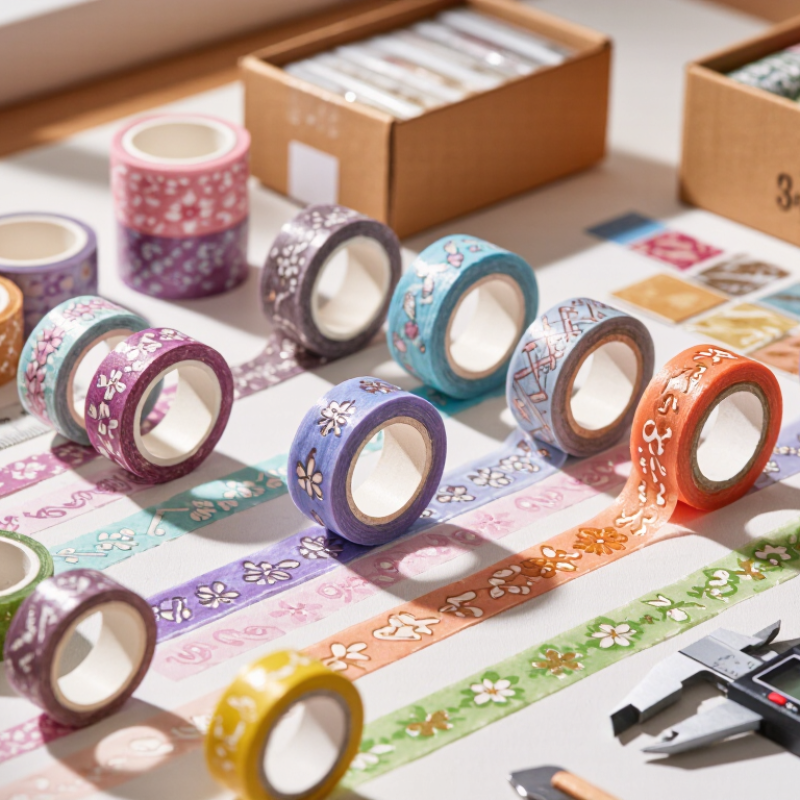
Die-cut washi tape is decorative paper tape cut into repeatable shapes, not merely sliced into narrow rolls. A supplier can produce scallops, labels, tabs, petals, or custom silhouettes. The adhesive usually removes cleanly from paper and many smooth surfaces. That matters when buyers prepare planners, gift boxes, invitations, or retail kits.
Bulk buyers choose it for consistency and speed. Every piece arrives with similar edges, spacing, and dimensions. Workers can peel, position, and pack faster than hand-cutting tape.
Grand View Research valued the global adhesive tapes market at about USD 86.9 billion in 2023, with continued growth expected through 2030. This broader figure does not measure washi tape alone. It still shows strong demand for convenient adhesive formats. Small details scale quickly.
Procurement teams should inspect liner release, roll tension, print sharpness, and adhesive aging before approving thousands of rolls. A 2024 IMARC market assessment also reported steady growth in decorative tape demand, linked to craft, packaging, and personalization. Estimates differ between reports, so buyers should question optimistic forecasts.
In practical testing, a die-cut edge may lift if the paper is dusty or heavily textured. Requesting production samples, carton photos, and batch documentation improves reliability. The cheapest quote can become expensive when peeling slows assembly.
When comparing die-cut washi tape suppliers, start with cutting precision. Small shapes should have clean edges, smooth corners, and consistent spacing. Ask for physical samples, not only digital proofs. Check the tape under normal lighting. Fine details can disappear after cutting.
Material quality matters just as much. Compare paper thickness, surface texture, print sharpness, and adhesive strength. The tape should stick firmly but remove without damaging common paper surfaces. Request samples on notebooks, cardboard, and coated packaging. One test is rarely enough. Humidity and storage temperature can change performance.
Production capability also affects bulk orders. Review minimum quantities, sampling fees, lead times, and monthly capacity. A dependable supplier should explain inspection steps clearly. Ask whether workers check color variation, die alignment, roll length, and damaged edges. Packaging deserves attention too. Individual wrapping can prevent dust, crushed rolls, and moisture exposure during shipping.
Price should be compared with total usable output. A cheap quote may include shorter rolls or higher defect rates. I have found that unclear specifications create expensive revisions later. Still, even careful buyers miss details. Confirm artwork tolerances, core size, carton dimensions, and replacement terms in writing. Responsive communication is useful, but documented answers are safer. Suppliers with traceable materials, consistent records, and transparent quality controls are easier to evaluate over repeated orders.
For bulk die-cut washi tape, supplier evaluation should begin with measurable quality, not attractive sample photos.
Grand View Research estimated the global adhesive tapes market at about USD 78 billion in 2023, with continued growth through 2030. That scale increases supplier choice, but it also hides uneven production controls. Request test results for peel adhesion, tensile strength, release performance, and dimensional accuracy. ASTM D3330 and ASTM D3759 can support comparable testing. Check the actual roll edge, backing smoothness, and cut detail under strong light. Tiny fibers matter.
Capacity needs evidence.
Ask for monthly output, machine count, material inventory, and recent production records. A supplier claiming high capacity should explain lead times during peak seasons. Confirm whether the quoted quantity means finished rolls or unfinished jumbo rolls. For customization, review proof approval, color matching, die tolerances, packaging, and replacement procedures.
A practical trial order should test three things: repeated shapes, fine lines, and adhesive consistency after storage.
Keep one sealed sample for later comparison.
Customization often exposes weak systems.
A 2024 report from Research and Markets identifies rising demand for specialty adhesive tapes across packaging and consumer applications, yet demand alone does not guarantee reliable execution. Ask how color variation is recorded. Request a tolerance sheet. If the supplier cannot explain batch control, caution is reasonable.
I would also inspect one imperfect roll. It may reveal more than a polished sample.
Sometimes, the best-looking sample is simply the newest one.
For 2026 bulk orders, custom die-cut washi tape commonly costs $0.18–$0.55 per roll at 1,000–5,000 units. Complex shapes cost more. Foil, layered printing, and special backing can add $0.05–$0.20 per roll. Ask whether the quote includes cylinders, proofing, individual packaging, and delivery. A low unit price can hide setup fees.
Minimum orders usually range from 500 to 2,000 rolls per design. Some suppliers allow mixed designs within one production batch, but each shape may still require its own setup. Confirm this in writing. It affects your real budget. I have found that a digital proof is useful, yet it cannot fully show adhesive strength or the final cutting edge. Request a physical sample when the artwork has small details.
Typical production takes 12–25 business days after artwork approval and payment. Sampling may require another 5–10 business days. Large orders, holiday demand, or multiple paper finishes can extend the schedule. Build in at least one extra week for inspection and corrections. Mistakes happen. A supplier should provide clear tolerances for roll length, color variation, and die-cut alignment. For dependable purchasing, compare three detailed quotations and check recent production photos, sample quality, response speed, and export documentation before confirming the order.
Choosing a die-cut washi tape supplier for a bulk order requires more than comparing unit prices.
A dependable supplier should understand adhesive strength, paper weight, cutting accuracy, and color consistency. Ask how they control these details during production.
Request physical samples before approving a large run. Check whether the tape unwinds smoothly and sticks without leaving heavy residue. Examine the die-cut edges under bright light. Uneven shapes often reveal weak cutting control.
For large orders, confirm minimum quantities, production capacity, lead times, and rework policies in writing.
A supplier should provide clear specifications for roll length, core size, packaging, and carton protection.
I once accepted a low quotation without checking color tolerance. The delivered tapes looked slightly different across batches, and correcting them delayed our campaign.
Supplier communication also shows operational reliability. Notice how quickly they answer technical questions and whether their replies include measurable details.
Confirm approval procedures for artwork, samples, and final production. Ask about inspection records, batch labeling, and moisture protection during storage.
Cost matters, but unstable quality can create hidden expenses through rejected stock and missed delivery dates.
Keep a written comparison of every quotation. It makes weak assumptions easier to challenge.
It is decorative paper tape cut into repeatable shapes. Common forms include labels, tabs, petals, and scallops.
Consistent shapes help workers peel, place, and pack faster. Hand-cutting usually takes more time and creates uneven edges.
Check clean edges, smooth corners, spacing, print sharpness, and roll length. Tiny defects become costly across thousands of rolls.
Apply samples to notebooks, cardboard, and coated packaging. Check firm bonding and clean removal after several hours.
Yes. Dust, rough paper, humidity, and storage temperature may weaken performance. A clean, smooth surface works better.
Confirm minimum quantities, sampling fees, lead times, and monthly capacity. Ask how workers inspect alignment, color, and damaged edges.
Individual wrapping can reduce dust, crushed edges, and moisture exposure. Request carton photos before shipment when possible.
Not necessarily. Shorter rolls and higher defect rates can erase the initial savings. I sometimes overlook small specifications, too.
Confirm artwork tolerances, core size, carton dimensions, replacement terms, and batch records. Written details reduce expensive revisions later.
Choosing the right Diecut Washi Tape supplier is essential for businesses placing bulk orders in 2026. Die-cut washi tape stands out through its pre-shaped designs, easy application, decorative appeal, and suitability for stationery, packaging, crafts, promotions, and retail products. When comparing suppliers, buyers should review adhesive performance, paper quality, print clarity, cutting precision, color consistency, roll size, packaging options, and customization capabilities.
A reliable supplier should demonstrate stable production capacity, clear quality-control procedures, responsive communication, and the ability to manage customized artwork. Buyers should also compare pricing, minimum order quantities, sampling policies, production timelines, shipping arrangements, and revision terms before making a decision. The best supplier is not always the one offering the lowest price, but the one that provides consistent quality, realistic lead times, flexible customization, and dependable service. By evaluating these factors together, bulk buyers can select a supplier that supports their budget, product requirements, and long-term ordering plans.